By Brian Hoop
Portland City Council voted May 7 to reject a plan by Portland General Electric for new transmission lines within the Linnton neighborhood’s section of Forest Park that would result in the clear cutting of 5 acres of trees.
PGE says the transmission lines are crucial to meet growing demand for electrical power. Construction of the new lines would result in cutting down 376 trees and filling two wetlands. This is in the vicinity of the habitat for the northern red-legged frog, an at-risk species that Linnton neighborhood leaders have organized to help save.
The controversial plan, originally denied in January by Portland Permitting & Development, was later approved by a city hearings officer. The Forest Park Conservancy and Forest Park Neighborhood Association appealed the decision to the City Council.
“Forest Park Conservancy applauds Portland City Council for their correct decision to deny PGE’s application to remove trees from Forest Park,” Executive Director Scott Fogarty said. “We hope this sends a message that our unique treasure must remain for all future generations to enjoy and benefit from.”
“The hard truth is that the need for the Harborton Reliability Project is unchanged,” says PGE Vice President Kristen Sheeran. “The evidence is clear that this is the least impactful of all options to the environment, landowners, and costs ultimately borne by customers.”
At an April 17 hearing on the appeal, speakers argued the city’s hearings officer ignored key criteria in the Forest Park Natural Resources Management Plan that guides oversight of the park. Specifically, they believe the utility company has not met necessary criteria to be granted an environmental review permit, which sets a high standard for development in the park.
PGE says their mitigation plan would include planting oak woodland habitat, native wildflower and grass seed, and riparian plants throughout the project area, as well as paying a $2.46 million in-lieu fee to Portland Parks & Recreation to help offset impacts outside the project area.
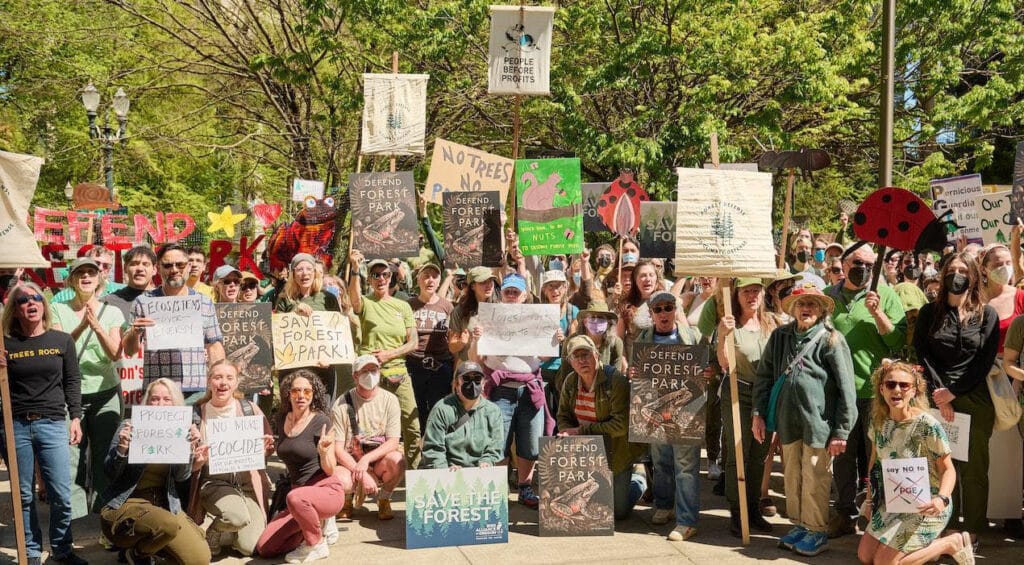
Rally outside Portland City Council hearing
on PGE permit appeal. Credit: David Chappell
City Council members acknowledged PGE’s claim for the region’s need for expanded electrical transmission capacity at the April 17 hearing. However, they expressed doubt about PGE’s assertion that the Forest Park site is the only feasible location for the project, and that the electrical grid is at risk of failure by 2028 if the project isn’t built.
“It’s quite possible that PGE could have made a demonstration of need,” said Councilor Steve Novick. “I just don’t think they’ve done it.”
Taking a long-term view, neighborhood leaders agree with critics who believe this proposal is a slippery slope to future PGE proposals. This plan is the third phase of a five-phase project which some believe might result in even further degradation to Forest Park including expansion of a transmission line through the park towards Scappoose.
“Today it’s 4.7 acres,” said Damon Motz-Storey, with the Oregon Chapter of the Sierra Club. “But the next phase, and the next phase after that, and other proposals yet to be seen will continue to point back to the decision made here today.”
The issue is not over as PGE can choose to appeal the City Council’s decision with the state’s Land Use Board of Appeals.