By Rob Lee
The high-tech industry in Hillsboro, and climate change, are fueling a rapidly growing local market for electricity. While specific plans are still unclear, in the next five years Intel will likely build one new semiconductor fabrication plant and rebuild another. Each fab plant uses as much electricity as 50,000 homes.
To meet this growth, PGE will expand delivery of power generated east of Portland to its new substation in Linnton, and on to Hillsboro. The most direct route to do this is through Forest Park, which would necessitate logging swaths of the totemic park.
PGE has proposed a new high tension line to run next to the existing BPA cut through the park. This would entail cutting down a swath 1000 feet long, 250 feet wide — about 6 acres — and installing 13 giant steel monopoles, on cement foundations, climbing the hill.
Here the plan is a bit perplexing, as this only takes the new line to where a smaller cut goes due west from the main BPA cut. The drawings PGE submitted shows the new line going both west and south along the existent BPA lines, but with no mention of on what the wires are hung, nor how much additional forest will need to be cut.
Also, PGE has already gotten permits to put in an underwater cable running down the Columbia and up the Willamette to the Linnton substation, inviting the impression that PGE is announcing the project piecemeal to finesse public reaction to the actual extent of lumber cuts planned for the park.
The spokesperson for PGE has said that the project is needed to “enhance reliability and resilience” of the grid, and the company has the significant leverage of retaining the original easements from when power lines were built in Forest Park decades ago.
In preliminary findings the Parks Department stated that PGE’s plan doesn’t meet the Forest Park Resources Management Plan (a statute passed in 1995 by the city council), and is “not consistent with the NRMP, and does not meet the approval criteria for projects requiring an exception,” from the NRMP. In another preliminary statement the cities’ Bureau of Development Services wrote that PGE’s plan doesn’t meet city criteria because of impacts to “high value resources and their functional values,” and suggests that an alternative site be found.
Marshall Johnson, a Natural Resource Ecologist for the Parks Department, is leading an effort to stop the project because the six acres to be logged includes increasingly rare native oak habitat; is near a bald eagle nesting site; contains a small stream meandering through dense native ground cover and large firs; and that two adjacent, pristine creeks, Marine Way and Harborton, will be exposed to the ravages of the logging.
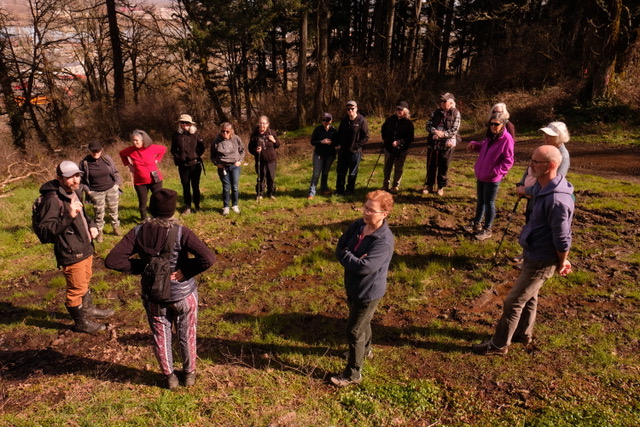
Group hikes to learn more about proposed PGE high tension line. Photo credit: Rob Lee
The logging will also impact the Harborton population of Red-legged frogs as it reduces and degrades the available habitat. Because PGE has the easement, forcing this project to find another site to build the electrical lines will be challenging.
Given this, a positive outcome for conservation-minded folks may be to force stiff mitigation, which could include PGE’s funding a list of projects in the park- like amphibian breeding ponds, a tunnel under Highway 30 to facilitate small animal migrations, and extensive restoration work in Forest Park itself — which is often touted as a crown jewel of our city, even as 50% of the park is now considered ecologically degraded by invasive plants.