By Mary Coolidge, Bird Alliance Oregon
Artificial light at night is an essential part of our modern urban lives for better AND for worse! Light at night is invaluable for extending our daytime activity past dark, but ubiquitous light trespass and glare do not have to be an unavoidable consequence of this modern amenity. We can and should design our lighting more thoughtfully to reduce the unintended impacts of light at night on entire ecosystems, including migrating and nesting birds, fish, mammals, amphibians, invertebrates and plants as well as our own human health, safety and culture.
All biological systems evolved under regular cycles of bright days and dark nights. Over 150 years, we have increasingly added light to the nighttime environment, and unfortunately, used too much light, to point up into the sky, to let it trespass onto neighbors’ property, and to leave it on all night. That light acts to pollute the nighttime environment, interrupts circadian rhythms, influences predator-prey relationships, and fragments dark habitats with serious effects on the natural world. We need to use it more wisely: good lighting design is a sound practice in the age of climate change, saves money and birds, protects human health and allows a better view of the stars!
Bird Migration
Spring migration is now underway. It will peak in Oregon between April 15 and May 19 as birds take a lofty path to their nesting grounds. Eighty percent of North American birds make their incredible journeys at night—including warblers, thrushes, sparrows, kinglets, siskins, and grosbeaks. Night migration helps them avoid daytime predators, save daylight hours for foraging, use the stars to navigate, and take advantage of a calmer atmosphere. Sadly, this tactic also exposes them to an increasingly widespread threat—artificial lights cast all night long into the sky from unshielded, overly bright fixtures on homes, streets, buildings, industrial properties, billboards, and parking lots. These sources accumulate to produce sky glow—the hazy dome of light over our cities that washes out the birds’ star map and can pull them off course into lit areas where they become entrapped in light and hit buildings.
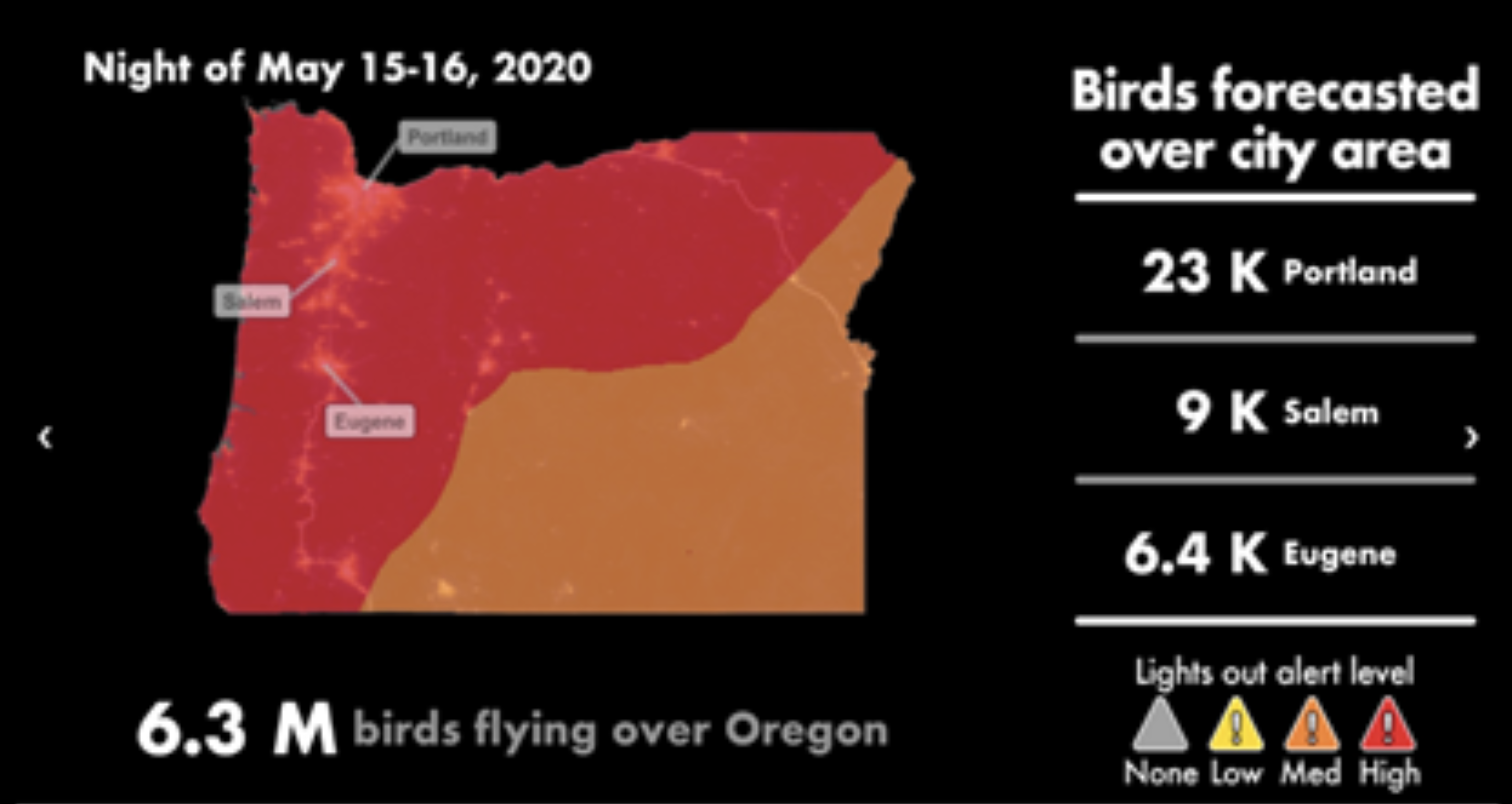
Thankfully, researchers are using radar technology to track movements of migrating birds, helping us understand migration peaks and alerting us to high movement nights when people can better focus their efforts: turning off unnecessary outdoor lights to help keep birds safe! You can help by going lights out from April 15 through May 19, or watching for lights out alerts!
What’s happening in Portland?
In 2020, Portland Bureau of Planning and Sustainability completed a Dark Skies Project: Strategies for Reducing Light Pollution, which ended with Portland City Council’s accepting a Dark Skies Report and Recommendations. The first recommendation was to develop an outdoor lighting code to address Portland’s growing light pollution. Portland is now developing that comprehensive code language to come before the City Council in 2025. A good lighting policy will plan for our nighttime environment, correct light-poor areas, address high traffic and pedestrian conflict locations, create a safe and vibrant nightscape for everyone, while setting standards for better lighting design to reduce skyglow.
We need your help to send a strong message to City Council to adopt the lighting code. Stay tuned in 2025 for your opportunity to help us get this passed!
For more information, contact Mary Coolidge at mcoolidge@birdallianceoregon.org
Here are simple things we can all do to help save our night skies:
• Watch for Lights Out Alerts on social media between April 15-May 19. Turn off your unnecessary lighting!
• Take the Pledge to Go Lights Out: https://audubonportland.org/issues/hazards/buildings/take-the-pledge-to-go-lightsout
• Turn lights off when you’re not using them.
• Make sure that all your lights are shielded and aimed down.
• Switch to motion sensors (or motion sensor bulbs).
• Use bulbs only as bright as you need!
• Choose warm light bulbs (yellower>whiter)!
• Build relationships with your neighbors—residential, commercial, and industrial—and talk with them about the impact their lighting is having beyond their property line.