By Nancy Hiser
The newly appointed Oregon DEQ (Department of Environmental Quality) manager of the Fuel Tanks and Seismic Stability program, Mike Kortenhof, reached out to Linnton last summer to initiate a dialogue about our concerns about the CEI (Critical Energy Infrastructure) Hub. Kortenhof, a hydrogeologist, has a 30-year work history with DEQ, including working at Willbridge in the Underground Storage Tank Program. Because of his experience, he understands the issues, knows the industry people involved, and is familiar with state and federal rules and regulations. He describes the current circumstances of the CEI Hub as a “hair on fire” situation.
This newly created program’s purpose is to “minimize the risk” of tank farms and is authorized by the passage of Oregon’s SB1567 requiring tank farms to undertake seismic stability studies and to submit mitigation plans to DEQ by June 2024. A Rules Advisory Committee (RAC) was recently appointed and is composed of neighborhood residents, industry representatives, activists, and local government officials; Nancy Hiser will serve as LNA’s representative. Following completion of the committee’s work, rules will be submitted to the Environmental Quality Commission (EQC) for adoption in September 2023.
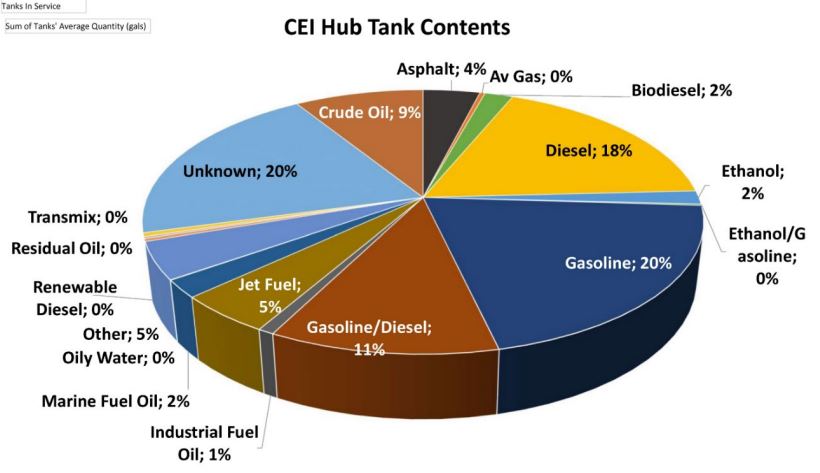
In a virtual meeting on August 6th that included 4 Linnton residents and 10 local activists who are dedicated to opposing Zenith Energy and reducing the threats the Hub presents, Kortenhof clearly stated the program’s mandate is for safety, not removal, of petroleum tanks. The analyses will be divided between re-engineering and emergency response; mitigation plans are required by June 2024 but mitigation is not authorized by this bill presently.
Of the 17 Oregon companies storing more than 200 million gallons of fuel that are included in this regulation, 14 are in Multnomah County: 12 at the CEI Hub, 1 on Swan Island, and one at the PDX airport. Two are in Columbia County, and 1 is in Eugene.
Looking to California, Washington, British Columbia, and New Zealand for best practices in seismic stability of tank farms, Kortenhof reported that most efforts in other locations focus on pipelines and connections, the first place leaks are likely to appear, and not on tanks. Oregon’s unique situation is partly due to our risk of a major tectonic plate shift caused by a subduction earthquake, unlike California with its higher risks of somewhat less major fault strike-slip earthquakes.
While most of those in the meeting were impressed with Kortenhof, some expressed concerns that DEQ may not succeed given the proven power of the petro-chemical industry and other political forces. If it does succeed, it will document one aspect of the CEI Hub risk but follow-up mitigation is critical.
And, many more efforts are needed to address public health, safety, and environmental risks.
Linnton activists will support DEQ’s program while continuing to pursue other risk-reduction measures. A major focus is to heighten public awareness. Many Portlanders are not familiar with the CEI Hub and the associated issues. If we are to effect change, we need public support. LNA is joining 15 organizations to co-sponsor a series of outreach events being launched on October 13th with a webinar called “Rumble on the River Community Forum” and will be followed with multiple in-person events throughout the city.