By Nancy Hiser
Multnomah County’s Board of Commissioners first discussed requiring liquid fuel facilities to adopt risk bonding in 2016. Little was publicly known about the measure to insure that facilities would assume financial responsibility for any damages they cause so that those costs would not fall to the government and the taxpayers.
A City of Portland-Multnomah County report on potential seismic damages as a result of a catastrophic earthquake at Portland’s CEI-Hub estimated they would total more than $2 billion dollars. That figure, adjusted for inflation, has risen to almost $3 billion.
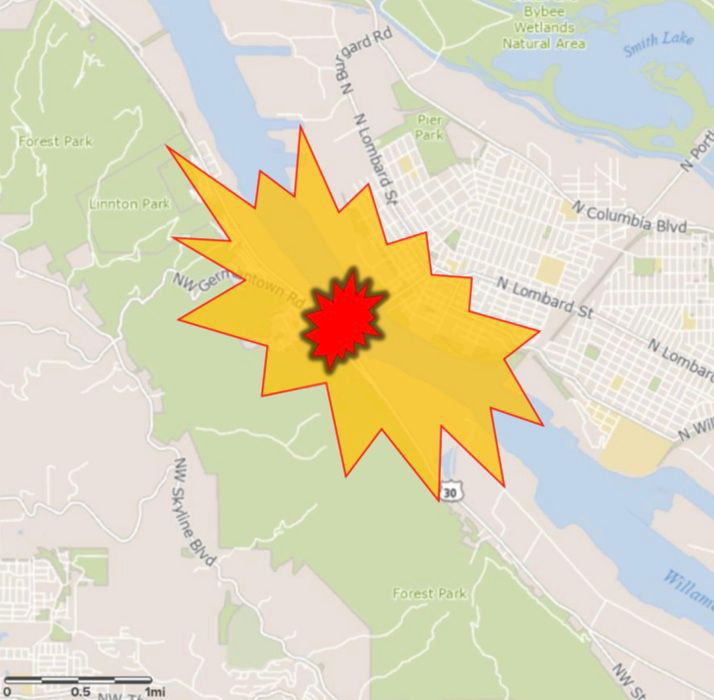
graphic image of a fuel tank explosion
Some believe risk bonds are an “after-the-fact” strategy and do nothing preventative. But the reality is that facilities would be incentivized to mitigate more quickly in order to pay lower amounts for risk bonds, meaning their resilience and community safety would both benefit.
In 2023 the matter came up again and an advocacy group, the Risk Bond Coalition, began meeting with Commissioners and the Board Chair to develop an ordinance. Commissioner Sharon Meieran was to take the lead.
In November, the ordinance draft presented to the MultCo board was voted down because it needed to be strengthened. A resolution affirming the Board’s commitment to address fossil fuel infrastructure risks passed unanimously. It’s due to be taken up early in 2025.
LNA issued a letter of support for this ordinance at the November 2024 general membership meeting.